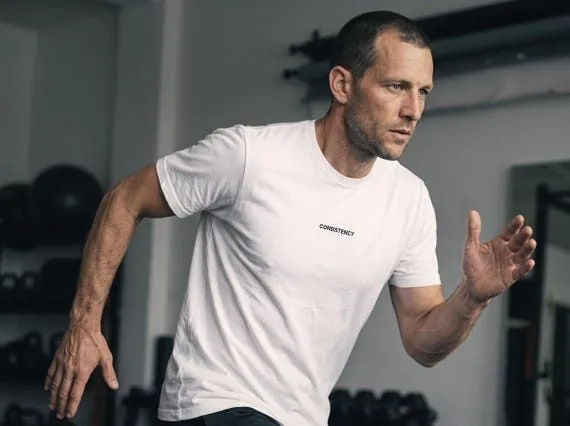
What to wear for a hybrid race is mostly a question of what you have already trained in. The format mixes running legs with stations like sled push, sled pull, lunges and wall balls, so your kit has to run, bend, grip and sweat without asking for attention. The short answer is a fitted tee, shorts or tights that stay put, one pair of tested shoes and nothing new.
Below is the longer answer, one item at a time, plus the stuff we leave at home. This is our experience from training and start pens, not a rulebook. Always check your own race's rules before you pack.
The short answer: a race day kit checklist
If you only read one section, read this one. Everything here has to pass the same test: you have worn it on a hard day and it did not annoy you.
- Tee: close fit, no flapping hem, worn in training at least twice.
- Bottoms: shorts or tights that survive a deep walking lunge without riding up or sliding down.
- Shoes: one pair you have both run in and pushed a sled in.
- Socks: your usual running socks, not a fresh pair from the expo.
- Extras: gloves only if tested, a warm layer for the wait, a dry tee for after.

The tee: fitted, tested, a little boring
A loose tee is fine on the run and terrible on the floor. During burpee broad jumps and wall balls a big hem flaps into your face, and on the sled it catches on your knees. Close to the body without squeezing is the target.
Fabric and print
A technical fabric dries faster. A good cotton tee feels better and you will wear it again on Tuesday. Either works if you have trained in it.
The bigger issue is the chest. A large stiff print sits where wall balls land and where the sweat collects. We wrote about this in embroidery vs print on a training tee: small embroidered text has no print layer to crack or peel.

That is why our own race tees are small and stitched. The Embroidered Consistency Tee says one word, which is about all the reading anyone does at the sled. The Reality Is Negotiable tee is for the moment the lunges start.
Shorts and tights: the lunge test
Do one slow walking lunge with your knee close to the floor. If the shorts ride up, the waistband rolls or the drawcord swings, they are training shorts, not race shorts.
Tights or short tights solve most of this. Shorts with a built-in liner are a good middle ground if you hate the feel of tights on the run. Pockets are optional: you will not use them, and anything in them will bounce.
Hybrid race shoes: one pair, two jobs
This is the hardest choice, because the run and the sled want different things. A tall, very soft running shoe can feel wobbly when you push. A flat gym shoe can feel like a punishment by the fifth running leg.
Most people we know end up in a stable, mid-cushion running shoe with decent grip. Test it on the same surface type as your race if you can, and do at least one sled session in it. If your shoes only ever saw the treadmill, race day is a bad first date.
Hybrid race gloves, grip and the small stuff
Gloves split the room. Some people like them for the sled rope and the carries, others lose feel on the handles and the ball. Check whether your race allows them, then decide in training.
- Socks: the pair you already run in. New socks find new places to rub.
- Tape: if you always tape a spot, tape it. Race day is not the day to stop.
- Hair: one tie you trust, plus a spare in the bag.
- Watch: set it up the night before, so you are not scrolling menus in the start pen.
The nothing-new rule
Every race has someone in a shiny new outfit discovering a seam on the second running leg. Do not be that person. Wear it twice before race day, and wash it once before you trust it.

The best way to test is a full simulation day: run, station, run, station, in the exact kit. It also tells you how your legs feel on the runs between stations, which we covered in how to pace a hybrid race.
Before the start and after the finish
Start waves can mean standing around in a cold hall. Bring an old layer you do not mind leaving in your bag, and take it off late.
After the finish, your race kit is wet and your plans for the evening are ambitious. Pack a dry tee, something warm and a bag for the soaked stuff. Ours is the Recovery 96H post-race tee, which states the plan for the next four days so nobody has to ask.

Everything else we make is in the shop, made to order in Switzerland. Pick the kit, then go and test it on a hard day. Type 2 fun is still fun, but only if nothing is rubbing.